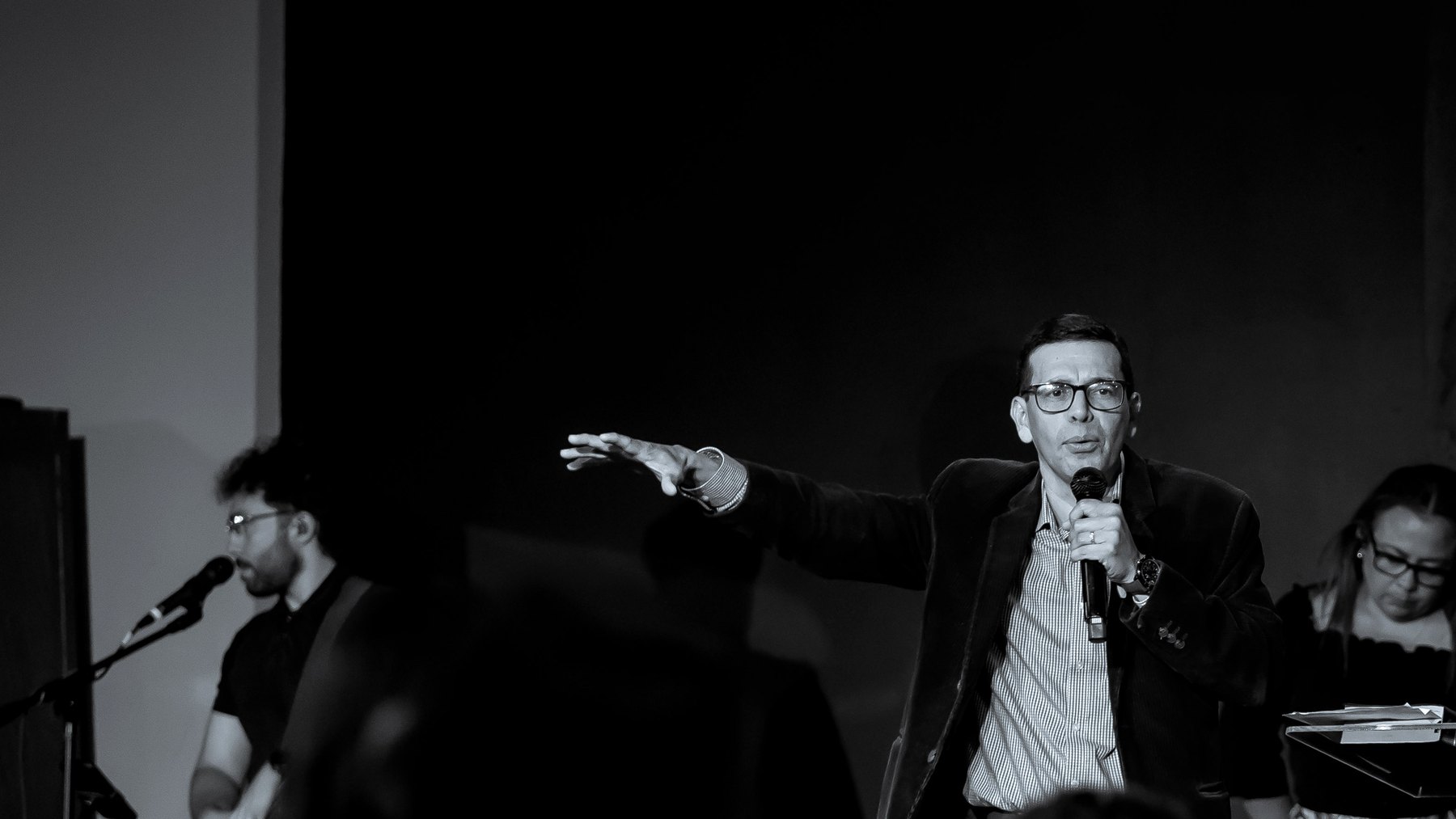
Why do we react the way we do, and why most of all with the people we love? Pastor Gustavo Tejeda started the morning with that question and spent the message under the surface of it, looking for roots. He named two of them, bitter root judgments and inner vows, and he told the church plainly that he hadn't wanted to bring this word. The Lord started speaking to him about it at home the Saturday before, he said, "and I have to be obedient to it."
He opened in English, joking that he needs to improve his, and had the church declare "The best is yet to come" before he moved to Spanish with the live interpretation. The joyful part was over, he joked; now came the painful part. Life and death are in the power of the tongue, he reminded everyone, and the Lord was inviting the church to speak blessing over their families, their marriages, their children and their relationships. Otherwise, "we are planting bad things for our present moment and our future."
Why do you react the way you do?
"Have you ever wondered why you react the way that you do?" He asked it twice and told people to take their time. Then a second question: "Could it be possible that some of our reactions today have roots in things that happened many years ago?" He compared it to the law of action and reaction from physics. Something was done to us, or we said something, and we respond.
The root nobody sees
On Wednesday, at the Bible academy, his wife taught a class on the character of a Christian and a leader, and she brought a tree. Pastor Gustavo asked the church what we see when we look at one: the leaves, the trunk, the shade, the fruit. What we don't see is the root.
"Many times we want to change the fruit of our lives," he said, "without asking what is happening beneath the surface." What is happening inside you?
He read Hebrews 12:15: "See to it that no one falls short of the grace of God and that no bitter root grows up to cause trouble and defile many." The verse opens with a warning, he pointed out. A bitter root grows from inside a person, and its fruit lands on other people.
We cannot conquer if our hearts have not been conquered.
Look at yourself first
So he asked for an exercise. Forget your wife, your husband, your children, even the person who caused the pain in your heart, and think about yourself. He used the safety talk on a plane: in an emergency you put your own oxygen mask on first, and then you help the child next to you. "If you are not prepared, you simply can't help the others."
The questions he gave were pointed. What words are we saying? What bitter root is growing in us? What actions am I doing that damage others? He read Galatians 6:7, "A man reaps what he sows," and then tied it to the series. What does a bitter root have to do with being called to conquer? Before we talk about conquering anything outside, "we need to conquer ourselves first. We cannot conquer if our hearts have not been conquered." Nor can we conquer, he said, while we carry bitterness or anger, or keep judging others over something now or in the past.
He was honest about how long it takes: one session won't do it, or two, or three. It is continuous work. Still, he said that anyone who is willing can be free, in the name of Jesus, of the bitterness that is ruining families, marriages and relationships.
1. Bitter root judgments
The first concept was the bitter root judgment. In his words, it is words and actions we have directed at other people out of a heart full of bitterness and resentment. It happens after a wound. We recognize who hurt us, and we also let the pain and resentment turn into condemning them for what happened. Someone causes harm, and our reaction is to throw out words of condemnation.
He was careful here. "It's not accepting that what they did to us was okay." The problem, he said, is when those hurts begin to govern our hearts and the way we see and condemn others. He drew a line between judging an action and judging a person.
Matthew 7:1-2 was on the screen as a warning to the church: "Do not judge, or you too will be judged. For in the same way you judge others, you will be judged, and with the measure you use, it will be measured to you." Then he answered the objection people raise, that someone caused a wound so deep they cannot forgive. "Of course you can't forgive, because you already judged," he said, and now you are sowing out of that judgment. "What you sow is what you're going to harvest." He called it a natural law and a supernatural law.
You are not alone
Ephesians 4:31-32 tells us to get rid of bitterness and anger, he said. No one is out of reach of getting hurt; we are people and we make mistakes, and one word, one look or one action can wound. But in front of that, we have the Holy Spirit. "You are not alone." He went through the fruit of the Spirit from Galatians 5 (love, joy, peace, kindness, gentleness, self-control) as the help God gives against bitterness and resentment.
It is God's will that we have a good life and happy marriages, he said. "As a church we cannot obligate you. It's your decision." If we don't make decisions, we ruin our own life and the lives of others, and the worst part is that they are the people we love most.
"We say that we love our children," he went on, and then we throw very offensive words at our wives, our husbands, our children, and say nothing more about it. "But they are listening." The child grows, the years pass, and what was sown in childhood starts to bear fruit in that child's marriage. "Church, be careful with our words," he said, "even our actions," and with our indifference too. Silence in front of problems and a lack of empathy also cause wounds.
2. Inner vows
The second concept was the inner vow. "An inner vow is a decision that we make in our heart," often in answer to pain, to protect ourselves from it. We say a word, and an inner vow is formed. He gave examples:
- "I will never trust anyone again."
- "I will never be like my father."
- "I will never allow anyone to hurt me again."
- "I don't need anyone."
- "I will never show how I feel again."
He asked how many had said the first one, and said he had said it in his own life. Words born out of pain become a rule of life and begin to govern us, many times without our knowing it. Years before, we said them on purpose and didn't regret them. Years later we start having difficulties, we don't guard our heart, and unforgiveness takes hold of our life.
That is where he read Proverbs 4:23: "Above all else, guard your heart, for everything you do flows from it." What we allow to settle in our hearts starts to shape the way we live, at home, in the family, in our relationships, and even at work. He described people who lose one job, go to another, and never find stability, "because there is bitter root."
"They always fight"
He closed with examples. Someone hurt by a father who never showed affection may form a bitter root judgment: my father was never there for me, he was cold with me, he didn't care about me. That judgment against someone they love turns into an inner vow: I will never need anyone, I will never let anyone make me feel that way again. Years later the same self-protection shows up in the marriage, as trouble expressing affection, being vulnerable or trusting.
Then he told his own story, from a workshop he did with his wife. When he had problems with her, his habit was to go silent, isolate himself and say nothing, and he believes that attitude "creates more problems than the problem itself," because it looks as if your wife or husband or family doesn't matter to you. The homework was to remember something from childhood behind it. He asked the Holy Spirit, and he remembered. As a boy, coming home from church, he would hear his mother and father fighting. He wouldn't go inside. He would get away, stay quiet, and calculate when it was safe to go in. "I was protecting myself," he said. But he was also carrying a judgment about his parents, that they always fight, and the inner vow he was making was that he was not going home. He probably also said he would never be like his father. Years later he got married.
Glory to God that he brings revelation, Pastor Gustavo said. God wants healthy marriages and healthy relationships, so it is necessary to give up the judgments we have spoken and the inner vows we have made. Otherwise, when your husband or wife tries to help, the answer may be "Don't be in my life," and without realizing it you are ruining your life and the lives of others.
Going to the root
"Today the Lord wants to give us freedom," he said, and asked everyone to stand. His prayer was that the Spirit of God would take hold of our roots, so we stop looking at the leaves and branches and go to the root. You can go to a seminar and think it is beautiful, he said, but if you don't deal with the root, the only thing you are seeing is the leaves.
He led the church in a prayer of repentance for judging others, renouncing every habit of judging in the name of Jesus and setting the fruit of the Spirit against it. He asked anyone the Lord had reminded of something to ask for forgiveness, to bring the inner vow born from a hurt before God, and to release every resentment and bitter root standing in the way of a healthy marriage. It ended on the verse behind the whole series: "I am more than a conqueror. Today I declare myself free of any inner vows, of any judgments that I have said."
Questions for this week
For your time with God, your family or your group.
- Think of the last time you reacted in a way you regretted. What might be under it?
- Is there a judgment you have spoken over someone you love?
- Have you made a vow like "I will never trust anyone again" or "I don't need anyone"?
- What words are your children, or the people closest to you, hearing from you at home?
Common questions
What is a bitter root judgment?
Pastor Gustavo described it as words and actions we direct at other people out of a heart with bitterness and resentment, usually after a wound. The pain turns into condemning the person who caused it. He took the image of the bitter root from Hebrews 12:15.
What is an inner vow?
"An inner vow is a decision that we make in our heart," often in response to pain and meant to protect us from it, like "I will never trust anyone again" or "I will never be like my father." Over time, he said, those words become a rule of life and begin to govern us.
What does this have to do with the Called to Conquer series?
His point was that we have to conquer ourselves first. "We cannot conquer if our hearts have not been conquered," and bitterness, anger and judging others keep us from advancing.
What Bible passages does this message use?
Proverbs 18:21 (life and death are in the power of the tongue), Hebrews 12:15, Galatians 6:7, Matthew 7:1-2, Ephesians 4:31-32, the fruit of the Spirit in Galatians 5, and Proverbs 4:23, in the Called to Conquer series, whose slide carries Romans 8:37.
Was this message preached in English or Spanish?
Both. Pastor Gustavo opened in English, then preached in Spanish with live English interpretation, as every Sunday celebration at Living Waters is in both languages.
Where can I watch it?
The full Sunday service, with worship, is on the Living Waters YouTube channel, and the sermon will be posted on its own there too. Sunday celebration is at 11 AM at 251 Stillwater Rd in Smithfield, Rhode Island, and you are welcome to come in person.