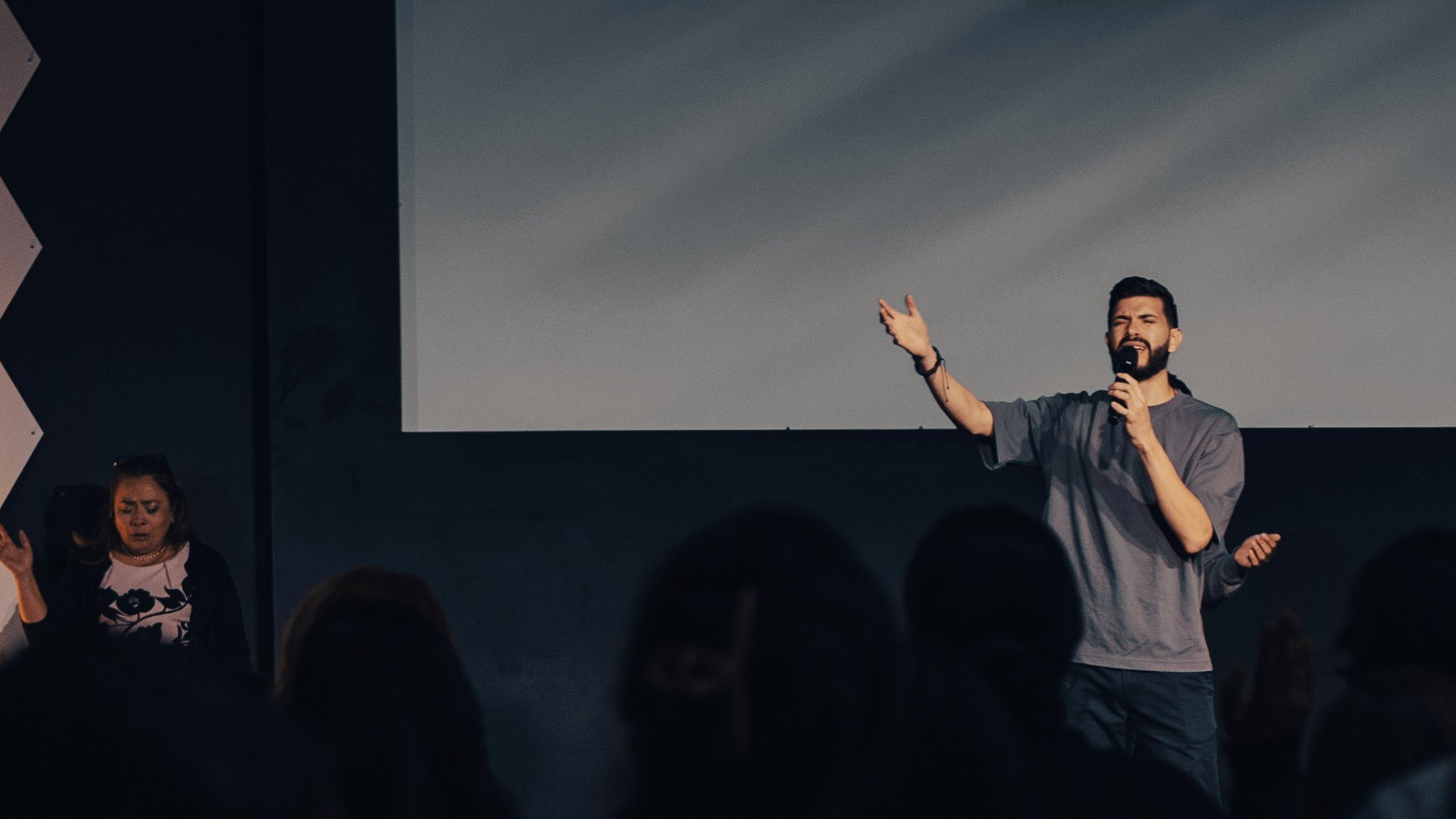
Being called to conquer means taking action, and Pastor Daniel summed up that action in two words: obey and possess. This Sunday he pointed both at the generations sitting in the room. "We are going to talk about obedience and take possession of our future generations," he said, "because we have multiple generations in this place." His case was simple. Each generation has to go further than the one before it, and for that to happen, every generation has to take responsibility for its own assignment.
Why was I born?
He started with a question most of us have asked at some point. Why was I born? What is my purpose? Someone put the same question to ChatGPT, he said, and the answer came back that it's something you will discover over the course of your life. A frustrating answer, in his view, because it doesn't answer anything.
"But you and I do know that the Word of God does have an answer to this question." He read Isaiah 43:21: "This people I have formed for myself; they shall declare my praise." We exist to worship God and to proclaim him. That purpose doesn't switch on by itself, though, as if we were programmed to do it automatically. "It is a territory that we must be able to conquer," and until we understand it and put it into practice, we won't live that life, and we won't be able to leave a legacy either.
More than a Sunday
Pastor Daniel described something everyone in the room recognized: walking out of church saying worship wasn't great today, it was boring, I didn't connect. Thinking that way, he said, shrinks the life of worship down to songs. We can spend years singing Sunday after Sunday without ever being discipled in what worship is for.
"Worship and praise is a lifestyle," and it plays out in "obedience, day in and day out." He warned that the message would be confrontational, because all of us disobey God every day. And if a Christian life amounts to a service on Sunday morning, "then your Christian life is just about a service on a Sunday morning."
The mandate, as he put it, is to disciple, and everyone has a part. Parents and grandparents first. Then brothers and sisters, sons and daughters, and in the church, leaders and pastors. "We all have a role as people who disciple others."
Every territory that has been won over shall be kept and sustained through obedience.
A generation that did not know God
Then Judges 2:10: "After that generation died, another generation grew up who did not acknowledge the Lord or remember the mighty things he had done for Israel." He called it probably one of the saddest verses in the Bible, and the saddest part is that it still happens today.
Joshua was one of Israel's greatest leaders. He led the people into the promised land, and they conquered it. After he died, a generation rose up that knew nothing of what God had done for their parents and grandparents. "So it's possible to conquer a land," Pastor Daniel said. You can be successful, you can have businesses and a very good life. "You can conquer the land, but at the same time lose your generations." Joshua, he said, missed conquering the most important thing.
The cycle of the lost conquest
A slide put the pattern on screen, the cycle of the lost conquest, and he walked through it. We see God's mighty acts, and that moves us to possess the land. "But when we then possess the land, we forget to obey." Settled in that land, we forget God and focus on the success and on what's going well, and we start handing the territory of our heart to other gods: our well-being, our money, our pleasure, ourselves.
Sooner or later we lose strength, and those idols vanish. "They're not going to save you." The territory is lost, "and it wasn't because of God. It was because of our disobedience." Then someone rises up in the pain and says, let us return to God, and the conquest starts over. The problem, he said, is that we repeat the cycle over and over, and not because we don't know who we are. "But rather because we have become disobedient." You can read the whole book of Judges and watch it happen, and it is also the story of our own lives, our nation, and many homes.
From Romans 1 he added a warning about people who knew God and still did not honor him. Then he turned to the parents and grandparents: "What territory are you conquering?" And: "What examples of obedience are you showing your children and grandchildren?"
Tell the next generation
Psalm 78 gave the other side: "We will not hide these truths from our children. We will tell the next generation about the glorious deeds of the Lord." He wants every one of us to be able to say it: I will tell the wonders my ancestors told me, I believe them and see them today, and I will teach them to the next generation. That is the responsibility of every parent, every grandparent and every leader in the church. "You and I are key to conquer the territory of faith, and that the next generation does not get lost."
That obedience is daily. He read Deuteronomy 6:4-9, the command to love the Lord with all your heart, and said the Israelites were intentional with their children. "So to obey this commandment is to be intentional and consistent with your family. Parents, tell your children. Teach them. Form them in the faith."
One mistake, he said, is thinking a child's heart gets won in Sunday school. "That's just a result. A result of something that happens at home." Every parent is responsible first for a genuine relationship with God of their own, so the legacy can pass to their children.
He brought up the phrase people use about young people today, that this is a fragile generation, a generation made of glass. Maybe so, he said. But the people who repeat it are the ones responsible for that generation, because "they were not instructed with regards to the word of God and his commandments." Every child should have a face-to-face encounter with Jesus. When that doesn't happen, the child grows into a teenager with a broken identity, and often it is because the adults at home are not seeking God themselves. Every territory, he said, is conquered by example.
A king at eight
Then the story turned. In 2 Kings 22:1-2, Josiah was eight years old when he became king, he reigned 31 years in Jerusalem, he did what was pleasing in the eyes of the Lord, and he followed the example of his ancestor David. For three generations the commands that were supposed to pass from parents to children had been lost, until God named an eight-year-old king.
Pastor Daniel asked us to think about that with him. How badly off were the adult generations, the ones responsible for the legacy of faith, that God had to name an eight-year-old? Josiah was the grandson of King Manasseh, a terrible king who handed the spiritual territory of the nation over to idols. Those idols look familiar today, he said: "Success, ego, our well-being."
Still, something changed in that third generation. Guided by God, the boy king decided to take that territory back. In 2 Chronicles 34, at sixteen Josiah began to seek the God of his ancestor David, and at twenty he began to clear Judah of its idols. All of it, Pastor Daniel pointed out, began when he was eight.
So he asked the church: what would happen if God put an eight-year-old up front today and made him the leader of this church? How willing would we be to obey, and to be confronted? Adolescence, he said, is when a person's identity is marked, and often when they decide whether to keep obeying or walk away from the faith. "Just like Josiah's decision shaped him," the decision a teenager makes today will mark them for life, and the parents and disciplers of teenagers are responsible for their formation.
The cycle of the conquest
A second slide showed the cycle of the conquest, the reverse of the first one. "It starts off with God's mighty acts," in our ancestors and in our present too, and our response is worship, a life of obedience at any age. "We were born to worship God." Walking that way, we possess the land, "from an identity that we already have," and from that place of success and blessing we teach the next generation, out of intimacy with God.
When Josiah heard the word of God, he saw the grave errors of his generation, "and he repents. And that's the first step towards conquest." Acknowledging that we lost ground through disobedience. Then telling the wonders of God on purpose, as Isaiah 43:21 says.
"Obedience opens the way toward true restoration. We are restored through obedience." Josiah renewed the covenant his ancestors had, but without obedience, he said, a covenant cannot stand. It breaks, and a space opens up, and that space gets taken by the one who comes to steal, kill and destroy. "Look at your family. Is there a space within your family?" It closes through obedience, and the territory handed to the enemy in our children and grandchildren "will only be regained when we obey." Then the line he built the morning on: "Every territory that has been won over shall be kept and sustained through obedience."
Youth is not a waiting room
He also spoke directly to the young people. "We can't wait to become adults, to get married, to have a title, a family, to then begin obeying God." If you have been living somewhere in the middle, a yes and a no, "today would be a great day to obey God." Hot or cold, you are here, and that is a result of something. Josiah decided at sixteen, and he wasn't formed in that faith, because his ancestors didn't teach him. Maybe our parents didn't teach us the way they should have. "The decision is still yours."
Paul wrote to Timothy, "May no one minimize you because of your youth," because young people often aren't taken seriously. "But rather be an example to the believers," in word, in conduct, in love, in spirit, in faith, and above all in purity, in a stage of life where sexual purity is under constant pressure. If an eight-year-old Josiah was an example to his elders, how much more us.
Youth, he said, is not a waiting room. "Our conquest begins with us," and that includes forgiving the places where we weren't formed well and still choosing the best for our lives. Nobody needs the title of pastor or leader to win a child's heart, "because even they look up to us. In silence. Maybe we don't even know it." Young people are the closest example a child has between childhood and adult life.
What territory are we conquering?
"We have all been called to conquer," he said as he closed. The land we possess comes second; the most important conquest is each generation making sure the next one knows God, "through obedience and discipleship." His last questions: "What territory are we conquering? And which land or part are we losing? What example are we giving to the next generation?" And: "Is your home marked by a genuine mark of faith? Or is it just being sustained by coming to church on Sunday morning?" To the young people: "Are you waiting for a title to then begin your conquests?"
He asked the church to stand and look at the people around them, the babies, the kids, the youth, the adults and the elders, and to underestimate no one, because each has a role as a discipler and an example. Then he asked if we, as Living Waters, are willing to build each other up, so that every time we worship together, others see "a heart that's led by example," he said, "not because we're looking to be perfect, but because we want to live a life that's surrendered to God."
Then the song, and he asked everyone to sing it looking at the person beside them, "for the next generation."
Questions for this week
For your time with God, your family or your group.
- What territory are you conquering right now, and what are you letting slip?
- Where do you see the cycle of the lost conquest in your own life?
- What has God done in your family that you have never told your children or grandchildren?
- Who is watching you in silence, and what example are they getting?
Common questions
What does "generations for Christ" mean?
In the Called to Conquer series, the call to conquer leads to action, and Pastor Daniel sums that action up as obeying and possessing. Here the territory is the next generation. Each generation is responsible for passing its faith on to the one after it through obedience and discipleship.
What is "the cycle of the lost conquest"?
The pattern Pastor Daniel drew from the book of Judges. We see God's mighty acts and possess the land, then we stop obeying, forget God and worship other things, and in the end we lose what was conquered. Someone calls the people back to God and the cycle starts again. The way out is obedience, which turns it into the cycle of the conquest.
Why does the sermon spend so much time on Josiah?
Josiah was eight when he became king, the grandson of Manasseh, after three generations had lost the faith. He began seeking God at sixteen and cleared the land of idols at twenty. Pastor Daniel uses him to show that a lost conquest can be recovered, and that it can start with one young person's decision, the way it did with Josiah at eight.
What Bible passages does this message use?
Isaiah 43:21, Judges 2:10, Romans 1, Psalm 78:1-4, Deuteronomy 6:4-9, 2 Kings 22:1-2, 2 Chronicles 34 and 1 Timothy 4:12, in the Called to Conquer series, whose slide carries Romans 8:37.
Was this message preached in English or Spanish?
Both. Pastor Daniel preached in Spanish with live English interpretation, as every Sunday celebration at Living Waters is in both languages.
Where can I watch it?
The sermon is on the Living Waters YouTube channel as part of the full Sunday service, with worship. Sunday celebration is at 11 AM at 251 Stillwater Rd in Smithfield, Rhode Island, and you are welcome to come in person.